
CAPTAIN'S STARLOG
Why “Tomorrow’s War” Will Not Be Based on Ketchup
Captain's Starlog: Entry 048
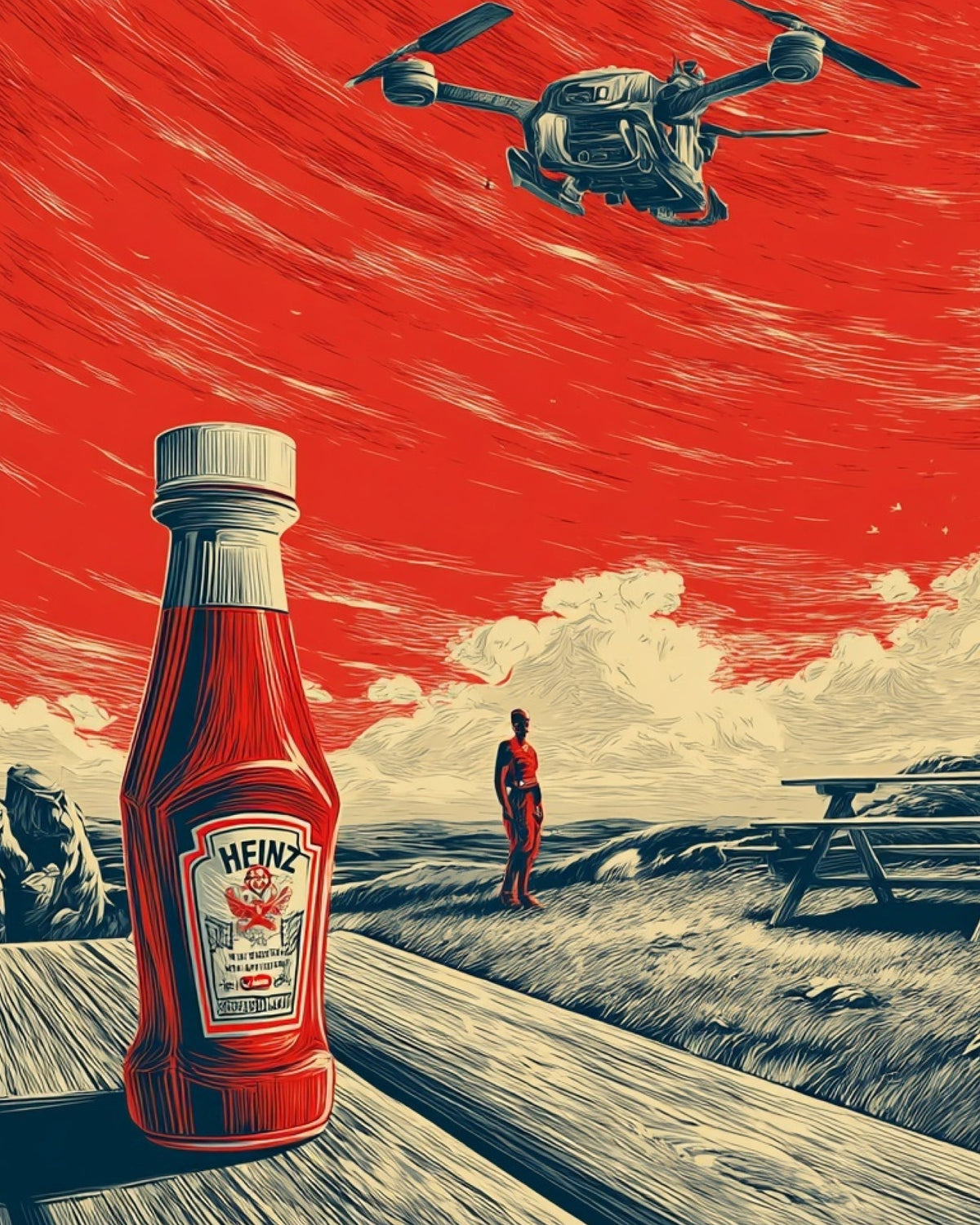
In our last post entitled, “Why Spices are Important to both 15th-Century Empire-Building and One-Way-Attack Drones,” we ended by noting the famous saying: “don’t fight yesterday’s war” and by asking the following three questions:
1. Is the United States falling into that “yesterday’s war” trap by developing low-cost drone platforms to mimic Ukraine?
2. If that is the “yesterday’s war” trap, then what does “tomorrow’s war” look like?
3. And, what is the next “spice” that drives innovation for that “tomorrow’s war”?
There is enough here to fill a few PhD theses for sure. But let’s first start where everyone starts when talking about military strategy: World War II.
Yes, it’s a topic so beaten to death that we apologize for the lack of imagination. But bear with us. This is going somewhere. Maybe.
World War I had tanks and planes and World War II had tanks and planes. What’s the difference?
First, yes, obviously the tanks and planes (e.g., the Messerschmitt Bf 109 and Panzers I-IV) developed in the inter-war period were a radical improvement over the tanks and planes of WWI. Faster and more powerful in every way.
But the real difference was Heinz. Not the ketchup. We’re talking about Heinz Guderian, the guy who was the primary architect of Germany's Panzertruppe (armored forces) and Blitzkrieg tactics developed in the 1930s, creating the concentrated and self-sufficient armored division concept of operations (i.e., CONOPs).
You see, in WWI the tanks were generally dispersed across infantry units.
Heinz said “nein” to this.
Instead, Heinz was inspired by ancient battles, particularly the stunning victory by the Carthaginians under the master tactician Hannibal Barca over the Romans at the Battle of Cannae in 216 B.C.
Hannibal arranged his battle line so that his center was relatively thinly manned and his wings were heavily manned. As the Romans charged, the center gave way drawing the Romans deeper and deeper into a pocket and then Hannibal’s heavily manned wings swung around and completely surrounded the entire Roman army in a giant pincer movement. It was devastatingly effective, destroying the entire Roman army.
Heniz’s plan leveraged that pincer movement concept. He created separate “Panzer” divisions of only tanks and, as we all know, he arranged the Panzer divisions as a concentrated spearhead that broke through the enemy’s front and then enveloped enemy units in those same pincer movements.
Poland, France, and the Brits can attest that this worked extraordinarily well.
So is that it? Will the answer for “tomorrow’s war” be: concentrate drones like Heinz’s Panzer CONOPs? It could be. And certainly there are efforts to replicate that outcome.
The US and China are spending serious cash on developing swarming drone technologies that essentially automate and coordinate a concentrated and large number of drones to hit a target, hopelessly overwhelming any defensive measure. That sounds effective (and scary).
But will that just mean that each side would eventually replicate the current tactics of Russia and Ukraine? Both sides have collectively learned that the ubiquitous presence of drones means it’s impossible to concentrate like the Panzer CONOPs. Instead, they disperse units, dig trenches, and largely do not use military assets like tanks, at least not in large numbers.
So then is “tomorrow’s war” less like WW II and more like WWI? It’s not an original question. Just look at footage from the Daily Mail and Kyiv Independent to see this reality. And many who are smarter than I have thought and written on this. So I’ll skip that line of inquiry.
Or is “tomorrow’s war” more like WW II’s Eastern Front and the T-34 tank? The Soviets didn’t innovate on Heinz Guderian’s tactics. They just made a cheaper, better, faster tank — and many, many more of them. Production in 1944: the Soviets produced approximately 10,000T-34 tanks vs Germany’s roughly 5,000 ish Panther and Tiger tanks.
That “T-34” approach is evidently the current thinking with everyone focused on reaching insane levels of scale in building drones. China has the capacity to produce millions of drones a year already. And the US’s Drone Dominance Program is banking on catching up to China by pushing a shock treatment to the US supply chain: increasing industry output and forcing cost reductions with specified per unit price points (and minimum order amounts), a radical departure from previous DoW procurement efforts.
And what about the “spice” driving innovation? We believe it’s the “cost of death.” It’s a morbid view for sure and we’ve talked this before in a previous post, entitled: “What the Fall of the Roman Republic, the Cost of Death, and Drone Operators have in common.” In summary: when it gets too expensive to kill lots of people quickly, then peace breaks out. When death comes cheaply, you have war.
If drones make death too cheap, then will we have ubiquitous war? We don’t know.
But every era thinks it’s living through unprecedented change — and every era is right, just not in the way it expects. The lesson from Hannibal, Heinz Guderian, and the T-34 isn’t that one approach is correct, but that wars are won by those who understand the system they’re operating in better than their adversaries.
If drones are reshaping that system by collapsing the cost of destruction, then “tomorrow’s war” won’t be decided solely by who builds the most hardware. It will be decided by who understands when, where, and whether that hardware should be used at all. And if history is any guide, the side that figures that out first won’t look obvious — until it’s far too late.
Comments