
CAPTAIN'S STARLOG
Why Spices Are Important to Both 15th-Century Empire-Building and One-Way Attack Drones
Captain's Starlog: Entry 047
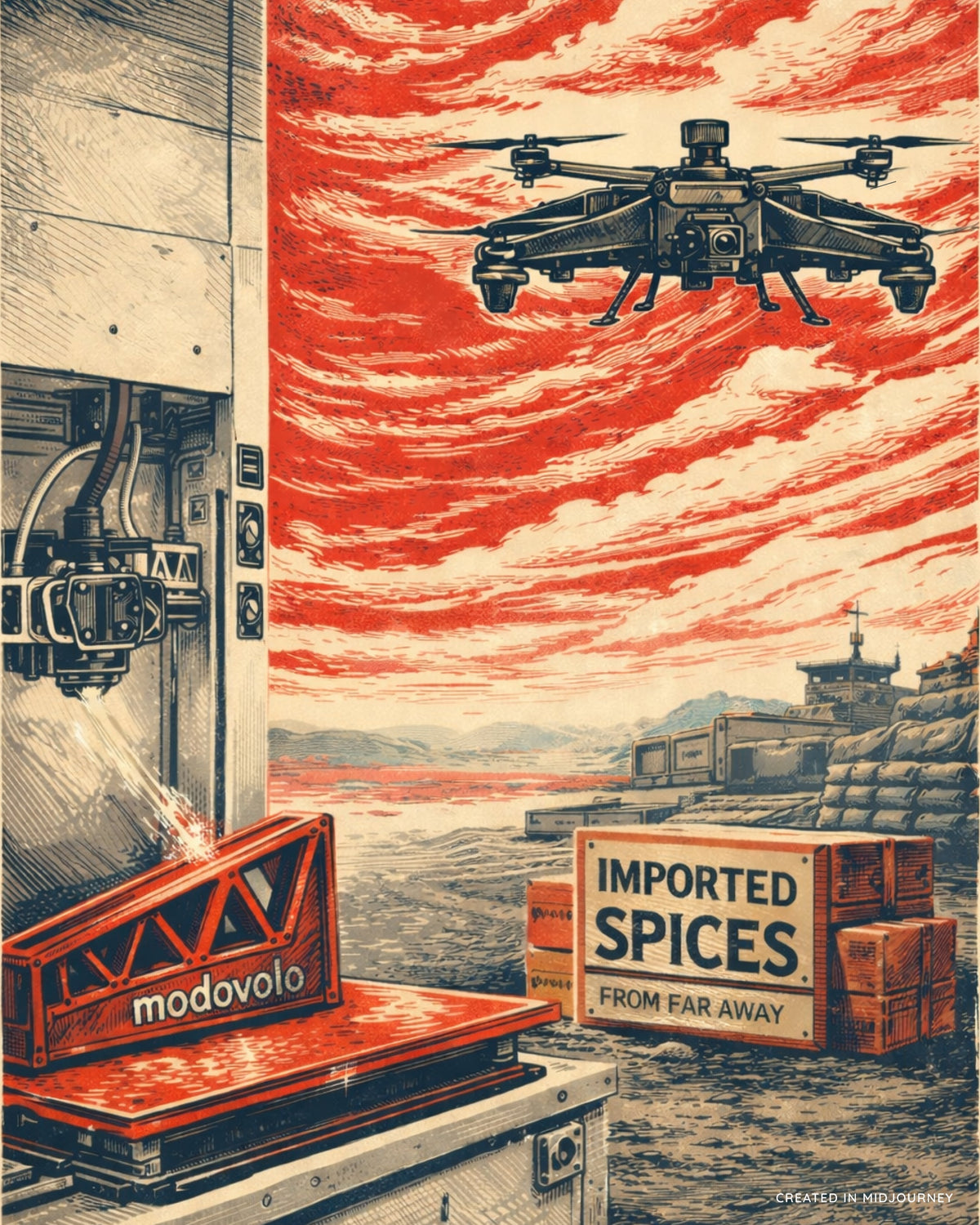
Cinnamon. Nutmeg. Cardamom.
Spices. Important to making food taste good, but not what one typically thinks about when thinking about things like empire-building or one-way attack drones.
Yet here we are with another enigmatic blog post title.
So let’s ask the question that’s on no one’s mind: why were England, Spain, and Portugal so willing and able to build trans-oceanic empires starting in the 15th century?
It’s astounding these countries were able to empire-build at all. Just a short hundred years earlier they could barely get out of their own way. They barely had navies. Their ships could barely handle coastal waters within sight of land, let alone undertake trans-ocean voyages.
And this is where little things like bad-tasting food have a bigger role to play in world history (and one-way attack drones) than anyone likes to admit.
You see, back in the Middle Ages pretty much everything was awful. Infant mortality was close to 90%. And if you survived childhood, you were lucky to survive past 25 years old. And in between being born and dying you had to eat incredibly bad-tasting food (if you had any food at all).
Why so bad?
Well, besides a lack of refrigeration, there was a distinct lack of flavoring. Spices we take for granted today like cumin, paprika, etc, just didn’t exist in Europe at the time. Even salt was a luxury. This meant you threw a piece of meat (if you could get it) or oats into boiling water and that was it.
Cooking shows were very short back then.
Then the Crusades happened. Starting in 1095 and ending in 1291 A.D., a series of Catholic Popes convinced a series of hapless European kings, dukes, and other assorted aristocrats with more time on their hands than sense, to schlep from England, France, Germany, etc., all the way to Jerusalem to “retake the holy land”.
It’s not clear why it was a “retake” because they had never “taken” these areas in the first place, but because the Catholic Church had the power of the thumbscrew and the rack, there weren’t a lot of people asking hard questions back then.
Eventually, the Europeans gave up on the “retake” thing and came back home. And they brought with them all sorts of wonderful things like spices.
All was well and good for another 150 years. The Europeans were happily importing spices and the Middle East crowd was happy to sell them.
Then the happiness came to an end. In 1453 A.D., after more than a century of war, the Ottoman Turks finally conquered the Byzantine Empire by capturing its capital city, Constantinople (which they then renamed Istanbul).
After waging war for so long, one of the first orders of business for the Ottoman Turks was to refill their treasury. Because Istanbul was conveniently located between the Europeans and the spice production centers, the Ottoman Turks realized that they were the middlemen. And as all middlemen do, they realized they could charge outrageous fees for the spices and the Europeans would pay it. Because bad-tasting food.
However, as with all things gastronomy, the Europeans got clever. They asked: “What if we could get the spices ourselves instead of paying the Ottoman Turks?”
This in turn spurred technological advancements such as the compass, the stern-post rudder, and the lateen sail which enabled the Europeans’ once feeble maritime capabilities to mature. In just a few generations they were crossing the Atlantic (Columbus), the world (Magellan), and doing the standard “Hey, what a great place to put an empire” routine of conquering, pillaging, etc.
All because they needed spices so they could make food that didn’t taste awful.
So. One-way attack drones and spices. What’s the connection?
Simply put, it’s innovation driven by cost.
The high cost of spices not only drove technological change but also a change in tactics (i.e., trans-oceanic voyages to get the spices directly instead of purchasing from the Ottomans). The same is true of the Russo-Ukrainian War. The high cost of war is driving technological change and a change in tactics.
Ukraine has developed an order of battle based primarily on FPVs and the Vampire drone. We’ve all seen the YouTube videos from Kyiv Independent and Daily Mail. Ukraine can kill a tank (or a soldier) for pennies on the dollar. Morbid thoughts for sure, but the lesson here is that Ukraine has figured out how to create orders of magnitude of “asymmetric advantage”. The high cost of battle drove Ukraine’s technological change and tactics.
And the United States is now playing catch up to Ukraine by developing its own low-cost drone programs and industrial base.
But there’s a famous saying: “don’t fight yesterday’s war.”
So is the United States falling into that “yesterday’s war” trap by developing low-cost drone platforms that mimic Ukraine’s? And if so, then what’s “tomorrow’s war” look like? What’s the next “spice” that drives innovation?
That’ll be the topic of our next post.
Comments