
CAPTAIN'S STARLOG
Why an 18th-Century Fashionista Would Have Loved the Modovolo Lift
Captain's Starlog: Entry 044
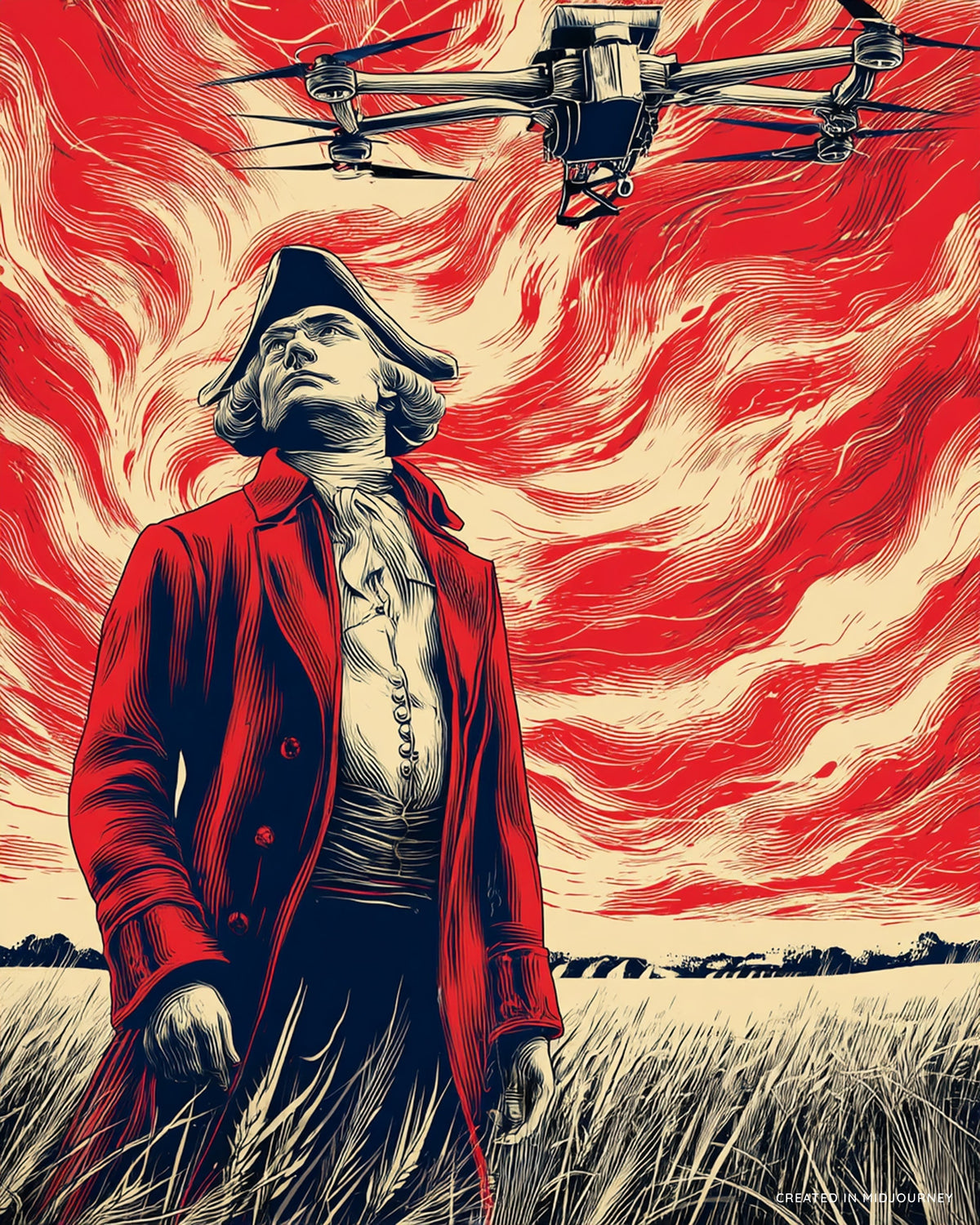
T-shirts, hoodies, and jeans. That’s all we wear here at Modovolo.
So we have no business at all talking about fashion. But we don’t let a lack of knowledge on a subject stop us. That’s especially true when we’re talking about the 18th century’s penchant for massive wigs. We’ve talked about this before in our tremendously influential article where we provided excellent (but surprisingly unheeded) advice to the FAA entitled, “A Recommendation to the FAA: How Part 108, the term “Big Wig,” and Mechanical Spring Watches are Connected."
But the 18th century fashion world didn’t stop at big wigs. The standard lineup of garments for men was: a linen shirt, waistcoat, full-skirted coat, knee breeches, silk stockings, a cravat around the neck, buckled shoes. Plus, the big wig was powdered with flour (to give it a popping white look) and then, because the wig wasn’t enough, they added a tricorne hat.
Everything was designed to inflict the maximum amount of discomfort. It’s as if the universal rule of the day was: if something was uncomfortable, it must be fashionable.
And the 18th-century Swiss mathematician, physicist, and doctor Daniel Bernoulli was not an exception to this rule. Because he was a fashionista and social climber, he had an impressive collection of all the most uncomfortable wigs and other 18th-century fashion trappings. And this gave him the fast pass to hit all the top social scenes of the time: the opera, the theater, and fancy-dress parties.

Portrait of Daniel Bernoulli. Mezzotint by Johann Jakob Haid, 1704-1767. After Johann Rudolf Huber. Archived by Smithsonian Libraries and Archives.
Yet, despite his fashion shortcomings and questionable social acumen, Bernoulli is one of our heroes. Because Bernoulli would have loved the Modovolo Lift. And, just like Modovolo, he was all about shameless self-promotion.
You see, in the brief episodes when Bernoulli was not at the top social events of the time, Bernoulli developed an “Effect” that not surprisingly came to be known as the “Bernoulli Effect.” Some call this the “Bernoulli Principle” but we think “Effect” has way more 18th-century vibes and that, when Bernoulli was doing all his socializing, he would have used his “Effect” to shamelessly self-promote himself — and likely as a pickup line for the ladies.
“Not to brag, but, you know, I have an ‘Effect’ named after me.”
So what was this “Effect”? It’s a core concept in fluid dynamics stating that where fluid speed is high, pressure is low, and vice versa. And it’s this “Effect” that makes things like airplane wings and propellers work. Because low pressure creates lift for wings and thrust for propellers.
Admittedly, Bernoulli didn’t know how to make anything fly. He developed his “Effect” nearly two hundred years before the Wright Brothers.
But he would have immediately recognized that the Modovolo Lift’s propellers were different in three important ways:
1 Chord Length
The Lift’s propeller has a massive chord length where other propellers have a short chord length.
The Lift’s propeller has a massive chord length where other propellers have a short chord length.
2 Twist
The Lift’s propeller has an exaggerated twist where other propellers have a slight twist.
The Lift’s propeller has an exaggerated twist where other propellers have a slight twist.
3 Construction
The Lift’s propeller is nearly hollow and lightweight where other propellers are solid.
The Lift’s propeller is nearly hollow and lightweight where other propellers are solid.
He then would have recognized that these differences made the Lift’s propellers particularly exceptional in creating a large amount of low pressure on the top surface, thus making a large amount of thrust. Efficiently.
We think he would have said something to the effect of: “I love how the Modovolo Lift maximizes my ‘Effect’ by creating the lowest pressure of any UAS propeller.”
And, lastly, he would have recognized that this article was just a clever way to shamelessly self-promote the Modovolo Lift.
Comments