
CAPTAIN'S STARLOG
What the Mechanical Spring Pocket Watch Tells Us About Drone Payload Capacity
Captain's Starlog: Entry 38
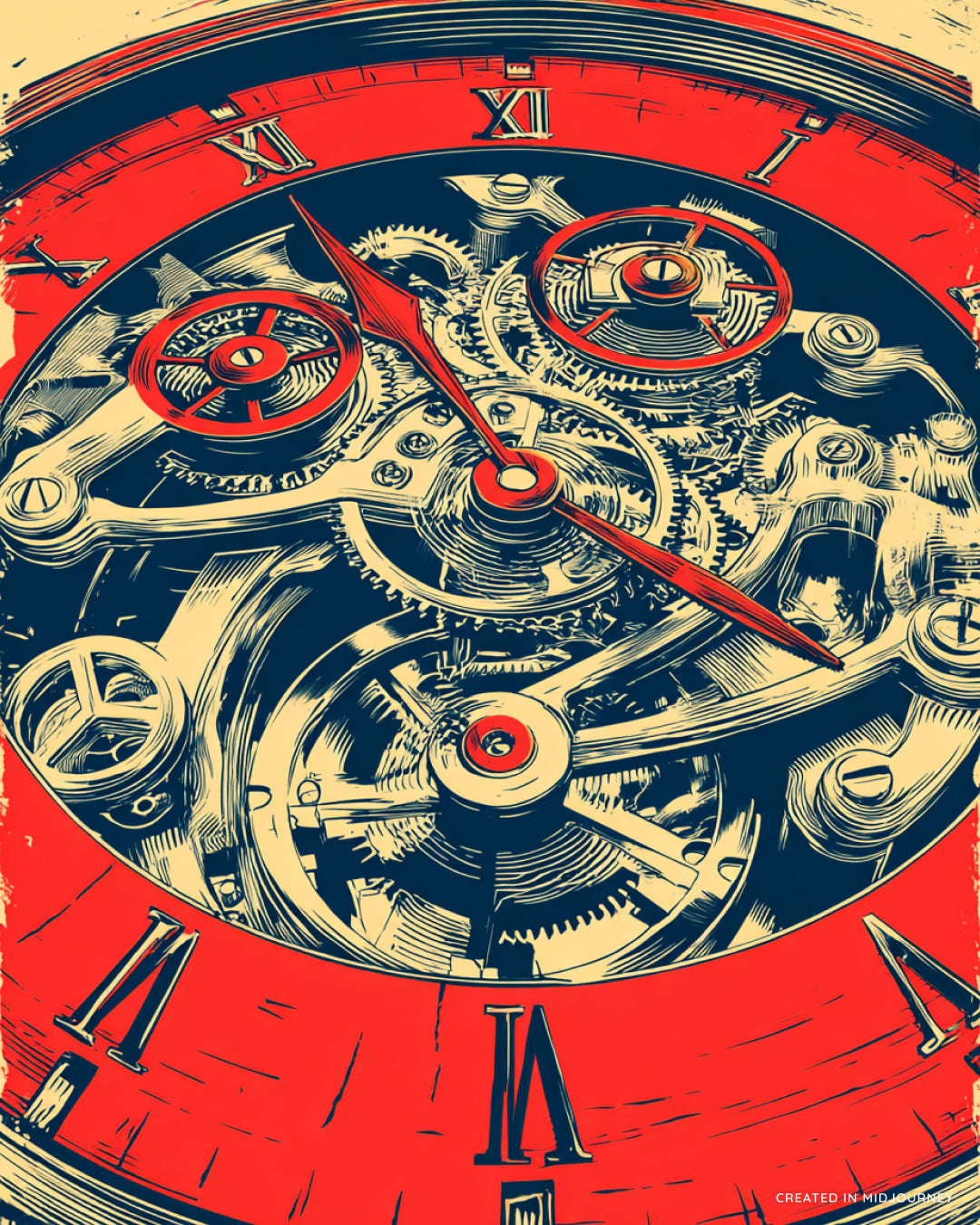
We’re big fans of Dad Jokes, so we thought you should know that the alternate title to this article was: “The mechanical spring watch. It’s now an anachronism.”
Yet, in all seriousness, mechanical spring pocket watches were the hottest technology around at one time. (Sorry! We’ll stop with the puns. Well, temporarily.)
Anyway, we’ve actually written about mechanical spring pocket watches before in an excellent article published by our good friends at UAV Commercial News entitled: “A Recommendation to the FAA: How Part 108, the term “Big Wig,” and Mechanical Spring Watches are Connected”.
While for some mysterious reason that article was completely ignored by the FAA, we did provide an insanely interesting discussion on how John Harrison, the preeminent timekeeping expert of the 18th century, developed a watch so accurate that it would only lose a few seconds over several months.
And that was a big hit with the Empire-making 18th-century-Brits. Why? Because you can use a watch to accurately calculate longitude (i.e., East-West position) and because accuracy in all things naval navigation is kind of a big deal.
For starters, if you know where you are and where you are going, you can find certain things (like those hapless colonials) and you can avoid certain things (like rocky shore lines from creeping up on you).
Because what’s the point of having an Empire if you can’t find it and what’s the point of a kick-ass navy if you keep sinking it?
So you could say that the mechanical spring pocket watch was the ultimate “payload” carried by those 18th-century British ships.
And that is basically what any ship (or aircraft) is: a payload carrier. And the best “payloads” and “payload carriers” win.
Which reminds us of the Modovolo Lift and its massive payload area of 10” length (25.4 cm) x 10” width (25.4 cm) x 6” height (15.24 cm) that can carry anything you want.
Yet, we hear you say: “wait, isn’t this a bit early in the article to start shamelessly promoting Modovolo?”
Fair point. Let’s get back to those cheeky and plucky Brits.
You see, the mechanical spring watch was really just the start of the Brits’ excellence in all things payloads - and those payloads were a critical factor in making them such exceptional Empire-builders.
Let’s look at two of our other favorite 18th-century British “payloads.”
Payload #1: Cannons. This might be a surprise to you but, as it turns out, cannons are particularly effective at destroying things. And people. And ships. Or, rather, cannons can be effective if you know how to make them.
Because in the 18th century cannon-making was still very much a trade of craftsmen and each cannon-craftsmen had their own mold and their own designs and sizes. There was no standardization.
And the cannon tended to be massively overengineered to avoid explosions (i.e., the kind of explosion where the cannon explodes instead of shooting the cannon ball) so they were heavy and hard to maneuver. And, because of non-standardization, the cannon balls fit rather loosely in most cannons, which radically decreased accuracy and range.
Then came the late 18th-century Brits who had figured the whole cannon thing out. First, they figure out metallurgy - especially how to cast iron. Second, they figured out how to bore cylinders with extreme accuracy. And, third, they figured out how to standardize everything.
All of this meant that British cannons were far more accurate, had far more range, and were also much lighter (so easier to maneuver). And that in turn meant that the Brits could be far more cheeky and plucky in destroying things. Like enemy ships. And enemy soldiers. All of which the Brits did a lot of in the 18th century, especially to the French The best payload carrier and payload wins.
Payload #2: Communications Nodes. The Brits didn’t invent signal flags communication, but they were the first to standardize it. Their “codified signaling system” (which Lord Nelson used to great effect in his victory at Trafalgar) allowed complex fleet maneuvers. Other navies (like the Spanish and French fleets) either had no communication system or had very rudimentary systems (such as pinning a table cloth to a shroud meant: “hey, want to come over for dinner?”).
OK, now that we’ve excessively proven the value of payloads to the Brit’s empire-building, we think we’ve now earned the right to do some more shameless self-promotion of the Modovolo Lift and to do a ridiculous comparison.
And what could be more ridiculous than comparing 18th-century British navy “payloads” to a drone “payload”?
Well, that’s easy. It would be more ridiculous to put a massive hole in the middle of a drone and name it a “lunch box.” But that’s exactly what we have done at Modovolo.
Why would we do something so ridiculous?
Payloads. We wanted to give you the most massive area ever to carry a wide range of payloads.
Modularity. We call our payload area the “lunch box” because, well, it looks like a lunch box. And just like actual lunch boxes, the Modovolo lunch box comes in all shapes and sizes so you can carry a wide range of payloads.
Slide-In Simplicity. Other drones require you to bolt your payload to the bottom. This takes time and it’s a pain in the ass. With the Modovolo Lift, you just slide your lunch box in from the top.
Safety. You’ve heard of “steel safety cages” in cars. The Modovolo Lift’s lunch box design is surrounded by a “plastic safety cage” that gives an incredible amount of protection in case of a crash.
Comments