
CAPTAIN'S STARLOG
Themistocles, the Best Drone Warfare Tactician No One Has Ever Heard Of
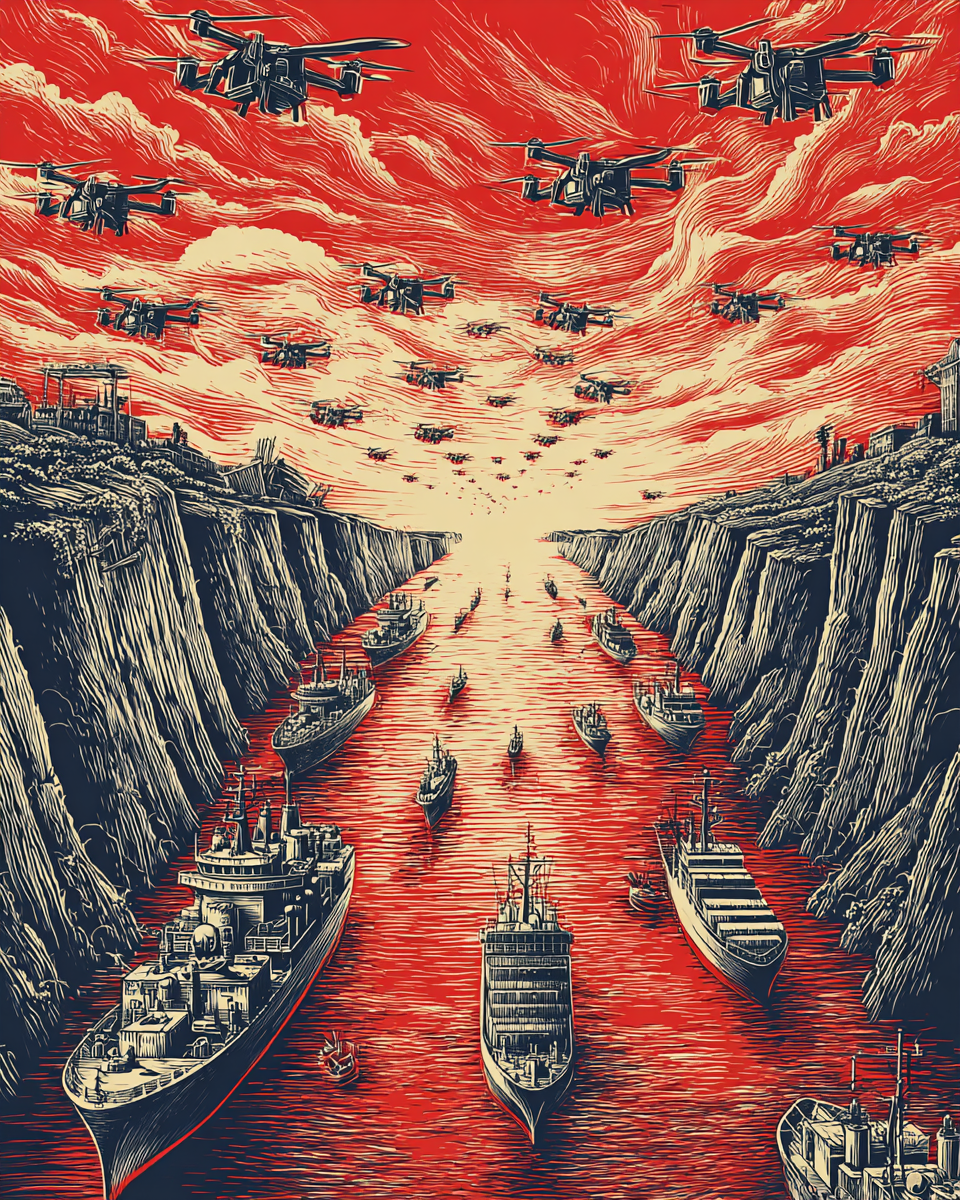
The Persian Wars.
For those of you with little appetite for grasping the obvious, this will come as a shock: the ancient Persians were one of the two protagonists in The Persian Wars. The other protagonist: the ancient Greeks.
The plot is fairly simple. In the 5th century BC, the world-conquering Persians decided to extend their already vast empire west, sending a vast army and navy to conquer the purportedly hapless Greeks.
Yet, the Greeks were not so hapless as the Persians suspected. And what should have been a fairly standard, run-of-the-mill conquest turned into nearly half a century of ass-whoopings for the Persians at the hands of the Greeks.
And this turned out to be a good ass-whooping for the sake of prosperity. Well, not so much for the ass-whooped Persians. But it was good for the fate of Western Civilization. Because without The Persian Wars, then there is a significant argument that Western Civilization would have never happened.
And that’s because pretty much everything that is important to the modern world was invented in that century by the ancient Greeks (mostly the Athenians) in the 50 years after the ass-whooping: philosophy, theater, science, history, and the idea of political equality.
Another way to put this: if there had been no ass-whooping and the Persians had conquered Athens (and the rest of the ancient Greeks), then no modern world.
So let’s talk about Themistocles, the architect of the early stages of said ass-whooping of the Persians.
For teams thinking about defense, infrastructure protection, or layered security, the central question is this: how do you create more protective depth without simply throwing more people and money at the problem?
Themistocles is not one of those military commanders whose name is ranked among the legends like Julius Caesar, Alexander the Great, George Patton, and Robert E. Lee. But Themistocles should definitely be there, perhaps even as #1.
That’s a bold claim, for sure, but hear us out.
First, the raw numbers are just daunting.
-
Super-Power vs. Not Super-Power. The ancient Persians controlled an empire ranging from Egypt all the way to India, ruling potentially as many as 50 million people. The Greeks were likely no more than 1-2 million people.
-
Army Sizes. Many estimates have pegged the Persian army that invaded Greece to be about 1 million men total (including non-combatants). The Greeks likely could field no more than 100,000 men total.
-
Navy Sizes. The situation with warships wasn’t much better. Persia’s navy by some estimates had over 1,200 and the Greeks were ⅓ of that at perhaps a maximum of 400.
Second, it’s not like the Persians were novices. They had conquered pretty much the entire known world by the 5th-century BC. No one at the time would have bet on the Persians to lose.
Third, Greece was not a country then. It was a collection of small city-states that were not united in any real way. In fact, quite the opposite. They fought each other almost non-stop. And it was a rare day that they would agree on anything. Indeed even in the face of total destruction by the Persians, they continued to bicker.
So Themistocles needed to not only figure out how to beat the most insanely large and seasoned army and navy the world had ever seen but also to figure out how to unite the constantly-bickering Greeks.
In short, he had to be both the world’s most astute military commander and the world’s most astute politician.
He also had a core handicap. There weren’t really any force-multipliers back then. Each enemy ship had to be destroyed one at a time. In close combat. By ramming.
And, because the Persians had almost a 10:1 advantage, he had to destroy a lot of them and he had to do this in a fairly short amount of time. The Greeks would only stay (barely) united for so long. He couldn’t use Fabian tactics.
Themistocles had to create tactics that would nullify the effects of the Persian advantages and expose a key weakness.
What then was the plan? Themistocles had two key insights. First, the Persians needed their navy to supply the army. So, if you destroy the navy, that one-million-man army can’t eat. And, second, the Greeks, especially the Athenians, were far more skilled in nautical operations than the Persians.
And skill mattered a lot when it came to naval warfare in ancient times.
Why? Well, let’s look at the trireme, the most common warship of the period. The name has two parts: (1) “tri,” meaning “three” and (2) “reme” meaning “oar,” i.e., if you had a cut-away view of the hull, you’d see one man with an oar at the bottom, another in the middle, and a third on top, hence “tri” + “reme.” Then on each side of the trireme there were 30-40 banks of oars, so about 180 rowers total.
So just moving in a straight line required an insane amount of coordination. And if you’ve ever seen eight people learn how to row a modern crew boat, you’ll understand why training and coordinating 180 rowers was no mean feat.
But there was another problem. The stern-post rudder had yet to be invented so all ancient ships had steering oars vertically strapped to each side of the hull. But these steering oars didn’t really do all that much steering. Which meant that the 180 rowers not only needed to provide propulsion but also needed to maneuver the ship. And the Ancient Greeks, especially the Athenians, were particularly good at maneuvering. By giving a complicated set of orders, the rowers could stop the ship, turn, reverse, and ram better than anyone.
Yet even with that skill, the Greek Navy could not hope to win a battle in open water against the Persian’s sheer numbers.
And this is why Themistocles lured the Persian Navy into the narrow straits between the island of Salamis and the Greek mainland. Because only here were the Persian numbers constrained. Only about half of the Persian warships entered the Salamis straits with the rest hanging out in the nearby gulf.
This meant that the Greeks only had to contend with roughly 600 Persian warships instead of 1,200.
The narrow straits also meant that the Persians and Greeks were crammed together and there wasn’t a lot of room for maneuvering. Something which also played to the Greek’s advantage. Because with their well-trained rowers, the Greeks could maneuver their ships to stop, turn, and ram in tight spaces. The Persians simply couldn’t.
The result of the Battle of Salamis? The Greeks, led by Themistocles, one of the greatest military strategists of all time, absolutely crushed the Persian navy.
So why would Themistocles be the “Best Drone Warfare Tactician"?
For one of the first times in the history of the USA, just like Themistocles and the ancient Greeks, we are facing an enemy that has far greater numbers than we have in men and equipment.
What then will happen at the straits between China and Taiwan? Just like the Persians, China has potentially overwhelming numbers.
So how will we devise tactics like Themistocles to nullify the effects of those numbers?
That will be the next post May 31, 2026.
Comments