
CAPTAIN'S STARLOG
The Sad and Not-So-Sad History of Manufacturing Automation
Captain's Starlog: Entry 33
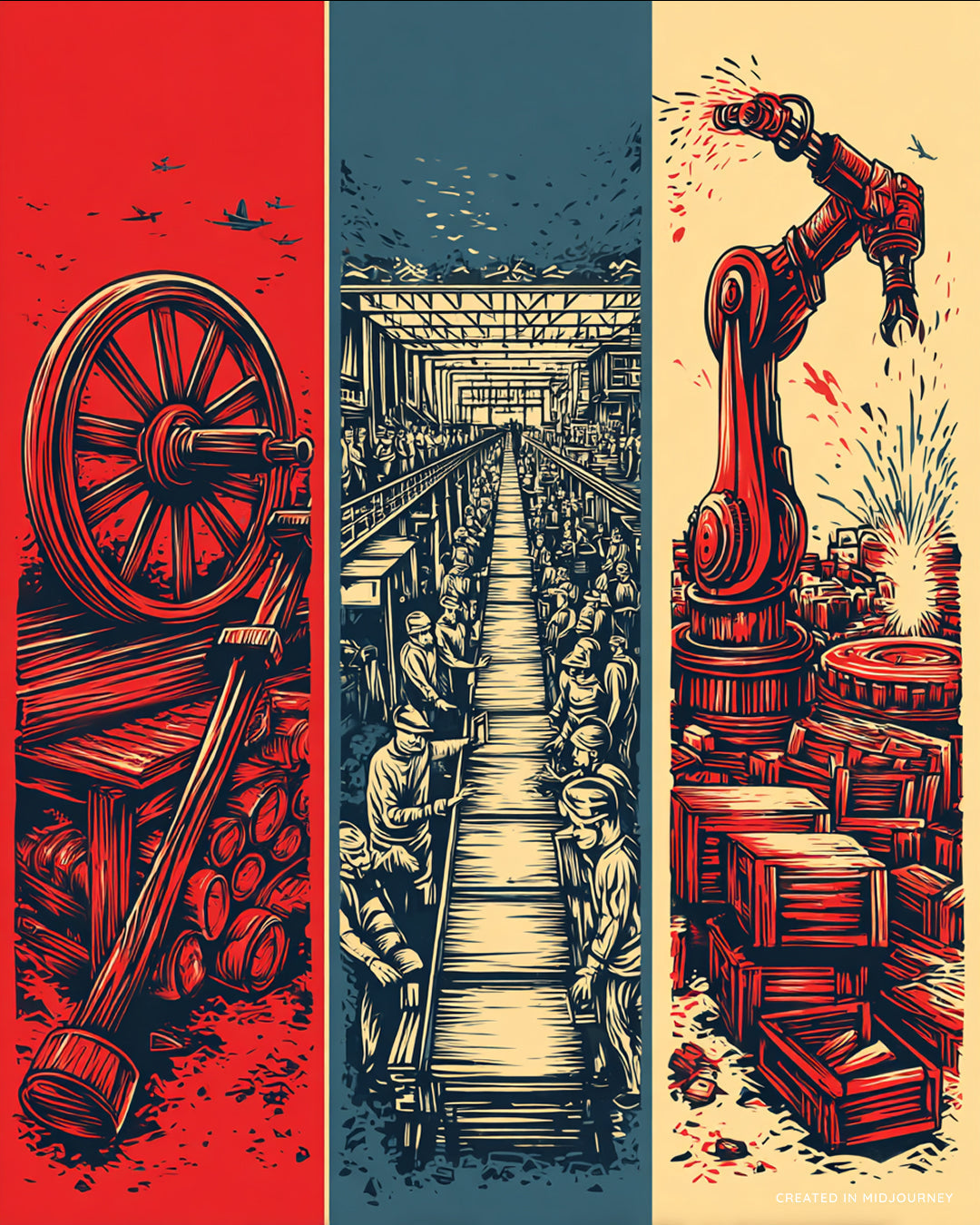
If you’ll permit us to get nerdy for a few paragraphs (or perhaps the entire article), we’d like to start by talking about the word, “manufacturing.” And about Latin (yes, the ancient dead language).
“Manufacturing” is made up of two Latin words: (1) “manus” which means “hand” (that thing at the end of your arm with five fingers) and (2) “facere” which means “do” or “make.” So the root-meaning of “manufacturing” is “make stuff with your hands.”
That’s a cool and interesting root-meaning because, starting at the dawn of the industrial revolution in the early 1800s, the one consistent theme has been: how do we make stuff without our hands?
That concept really got going when Watson’s steam engine and Cartwright’s “power loom” (which was powered by a steam engine) changed the textile industry overnight (well, over 40 years, but who’s counting?). For the first time ever, you didn’t need thousands of people with thousands of hands weaving fabrics…by hand. All you needed was one “power loom.” No hands required. Well, some hands.
And that dream of manufacturing without hands (or fewer hands) has persisted all the way to the present day (or near-present day).
1980s: The Automation of General Motors. Roger Smith, the CEO of General Motors in the 1980s, was many things (some may say no thing), but it is fair to say that he was not a people person. He viewed his workers as an unfortunate cost of doing business and something that needed to be eliminated. At the 1981 GM annual meeting, Roger said: “Over the years the earnings of U.S. autoworkers have gotten too far out of line with our foreign competition…We must reduce this huge labor cost handicap we have in America…”
Roger’s core solution? Replace workers with robots. Roger called this the “lights-out factory” of the future. The scale of his ambition and the effort was just staggering. Under Roger, GM spent around $90 billion in automation, robotics, and plant modernization over an 8-year period.
But keep in mind that this is the 1980s. When processors were measured in kilohertz and hard drives barely existed and there was barely kilobytes of RAM. The result? Most of these advanced systems failed: robots painting each other, robots welding doors shut, robots smashing into each other, and robots just generally being a nuisance by refusing to work at all (pun intended).
Plus there was massive backlash from this robotic automation push. Union-management dynamics grew increasingly strained. UAW President Owen Bieber captured the atmosphere in 1987: “Animosity is an accurate way to describe labor‑management relations.”
This is at a time when Roger needed his workers’ help in a big way. The Japanese were crushing American manufacturers and GM’s market share slid from 44% in 1980 to about 35% by 1990, but by 1993, after Roger had retired, most of the robotic automation initiatives were stopped and removed from the factories. The “manu” in “manufacturing” was brought back in.
Early 1990s: Lexus. In a rare misstep, Toyota also pushed in the 1990s to fully automate its Lexus plant in Tahara with robots performing (or trying to perform) tasks like hood alignment, automatic welding of suspensions, and sanding. It was a far less ambitious effort than General Motors (both in time and money), but it was still a costly mistake, by some estimates exceeding $1 billion at a time when Toyota’s net profit was no more than $3 billion. And so after 2 years of effort Toyota had learned enough from the experiment to know that humans were better. By a lot.
Within 6 months, through its lean production principles Toyota had achieved productivity beyond what was promised by the robots. This also led to Toyota re-emphasizing its foundational principle of “jidoka” (automation with a human touch) which has a strong preference for “just enough automation”—choosing low‑cost, reliable systems that could pay for themselves quickly and that don’t replace the flexibility and judgment of workers.
2010s: The Algorithm. And then there was Elon. Like Roger Smith from the 1980s, Elon was hell-bent to fully automate the first Tesla factory in Fremont, California. And like General Motors and Toyota, Elon found that too much robotic automation was a problem. This led to two things. First, Elon made the now-famous admission on April 13, 2018 that: “Humans are underrated.” Second, Elon then promulgated his now equally-famous “Algorithm” on how to do manufacturing:
-
Requirements. Make your requirements less dumb. It’s dangerous if a smart person gave you the requirements because you might not question them enough.
-
Delete, Delete, Delete. Try very hard to delete a process step. If you are not adding stuff back in later, you are not deleting enough. Bias is to add a part or step in case we need it. No hedging bets.
-
Person Accountability. Any constraint or requirement must come from a person and not a department. Everyone is a Chief Engineer.
-
The Best Part is No Part. The most common mistake of an engineer is to optimize something that shouldn’t exist. This is a mental strait jacket because the engineer is trying to answer the question asked and not asking why you are even asking a question.
-
Accelerate Cycle Time. Make things go faster through manual processes.
-
Automate. Automation is the last thing to be considered.
The Many Hands of Honda. Interestingly, these are lessons that Honda never had to learn. Despite being one of the most efficient (if not the most efficient) manufacturers on the planet, Honda has always had the least automated factories and the most amount of people on its production lines.
Honda has never “underrated” humans because they know that their humans are why they are so successful. So while Honda has automated things like welding and stamping (where safety has been a concern and machines are more suitable because it is a highly repetitive task), Honda routinely uses humans where other companies have tried to automate.
The result is an insane amount of flexibility. Many production lines produce many different variations of cars and if a new model is introduced that requires a new production line, this takes days, not months unlike General Motors which requires months to change over a production line because GM’s engineers need to reprogram all the robots.
What does this have to do with drones? Well, that’s where our long history of shameless self promotion plays out. We’re big fans of Toyota, Honda, Tesla, and SpaceX because those companies have proven that the path to greatness lies in figuring out how to build things at scale. Their product really is their factory at the end of the day. And that’s what we are shamelessly copying.
We have developed our own proprietary production process that has our proprietary 3D printer at its centerpiece, something which we call the “Big F***ing Printer” or “BFP.” If the BFP were a car, it would be the size of a dump truck, with the engine of a Ferrari, but the cost of a VW. It can print faster and better than 3D printers costing $500k but it is a fraction of the cost.
And that means that we can scale to build drones like no one else and drive down the cost of each drone like no one else.
Comments