
CAPTAIN'S STARLOG
Gaius Marius: The Best Drone Designer No One Has Ever Heard Of
Captain's Starlog: Entry 34
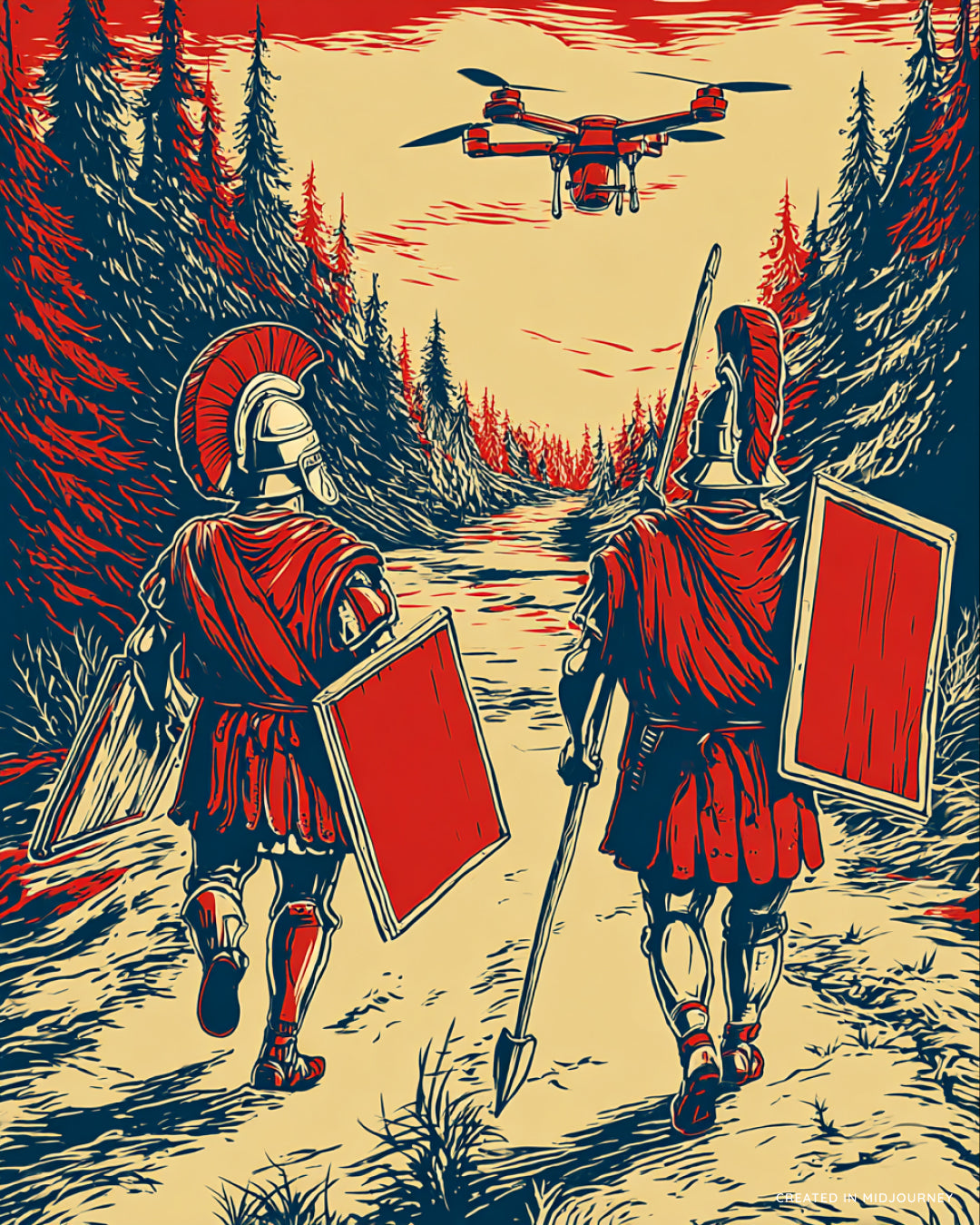
One of the fundamental questions we ask ourselves all the time here at Modovolo is this: what if we were all under five-feet tall and barely weighed 130 lbs each and there was a massive horde of 300,000 Germanic warriors — all of whom were a strapping 200 lbs each and over six-feet high — that wanted to kill us and take our land?
Sounds surreal but this is the exact question confronting the ancient Romans over 2,000 years ago.
Some background. At around 120 B.C. in the northern lowlands of what is today Germany, a powerful storm caused ocean waters to flood the lands of the Cimbri and Teutones, two Germanic tribes who had a penchant for animal-protein-based diets and a penchant for being the ancestors of Arnold Schwarzenegger.
But ocean water contains salt and salt kills foraging plants for herd animals like cows, which in turn meant that Cimbri and Teutones needed new foraging grounds in order to support their animal-protein-based diet and their Arnold Schwarzenegger-ness.
So the Cimbri and Teutones left northern Germany and headed south. Way south. And they soon realized, as did Arnold Schwarzenegger 2000+ years later, that living in an area with lots of sun (and lacking massive storms) is nice. Arnold Schwarzenegger found California in the 1980s and the Cimbri and Teutones found Italy in 113 B.C.
The only problem was that there were Italians living in Italy at the time and the key Italians then were the Romans.
But given that the ancient Romans ate a lot of bread and the Cimbri and Teutones ate a lot of animal protein, there was that small bit about physical size discrepancy I mentioned earlier. The Romans generally were very small and the Cimbri and Teutones were generally very large. And ripped. Like Arnold Schwarzenegger. Think 300,000 men of Conan the Destroyer dimensions.
That meant the Cimbri and Teutones handed out quite a few ass-whoopings to the Romans. Three Roman armies were completely destroyed from 113 B.C. to 105 B.C., nearly half a million men gone out of a total population of probably no more than 5 million Italians. As you would expect after the third ass-whooping, the Romans were properly worried that their empire might fall 500 years too early (which ironically finally happened over 500 years later in 476 A.D. at the hands of another German tribe…but that is a story for another day) and so something needed to be done.
That “something” meant handing over the reins of leading the fourth Roman army to Gaius Marius in 104 B.C.
Gaius Marius was the general’s general and, because he was especially good at killing large amounts of people very quickly and enslaving the rest, he was massively famous in the Roman world. So famous in fact that there was reportedly a large demand by Roman teenage girls for Gaius Marius “action figures” (i.e., small statues made of clay). And, yes, enslaving was unfortunately an important success metric in ancient times.
And the “Battle of Aquae Sextiae” in 102 B.C. was one of those times when Gaius Marius did the “killing and enslaving” thing exceptionally well.
Here was Gaius Marius leading an army of a mere 35,000 men (recall that they were essentially midgets of less than 5 feet of height and under 130 lbs) versus the 300,000 giant men of the Cimbri and Teutones. Yet, even with these ridiculous odds and physical size discrepancies, Gaius Marius won a complete and total victory.
How?
For starters, Gaius Marius drilled the crap out of his men. So while the army was small, it could give an outsized collective punch and the Cimbri and Teutones did not do any drills. In fact, their entire military strategy was to just run at the battle line screaming their heads off. And, well, the Cimbri and Teutones relied on the fact that a few hundred thousand Conan the Destroyers just looked scary.
Second, Aquae Sextiae was nothing more than a small hill, but on that small hill Gaius Marius had his small army build a series of ditches with spikes and other fortifications. And then with his small army Gaius just waited. And waited. And waited some more even at the extreme taunting of the Cimbri and Teutones. All this until the giant Cimbri and Teutones finally rushed up the hill with the determination of 300,000 Conan the Destroyers. But the combination of fortifications and the steely grit of Gaius’s well-trained small army was far too much.
The Roman strategy was deceptively simple. The Romans start by launching their “pila” (i.e., basically spear-shaped attack drones) into the tightly massed Cimbri and Teutones, taking out a large percentage of the Conans, and, then the Cimbri and Teutones who made it through the pila and ditch spikes just thrashed themselves against the Roman shield wall. Then that small well-trained Roman army of 35,000 men protected by their shield wall dispatched the Conans in short order.
So job done. Lots of dead Cimbri and Teutones and lots of refugees to turn into profitable slave sales.
But there was so much more to Gaius Marius than just brilliant generalship. He was also a brilliant drone designer.
You may be thinking: ok, but how was Gaius Marius a drone designer? Let’s go back to the “pilum” (which is the singular of “pila”), i.e., the spear that the Romans launched first at the Cimbri and Teutones with devastating effect.
Why is the “pilum” the equivalent of a drone?
Well, what even is a pilum? It was a simple design that you're likely familiar with: a very small diameter iron pointy bit clamped onto a wooden shaft. There’s a very cool video showing a pilum here: https://youtu.be/ZxY3CzN2Kkc?feature=shared
So Gaius Marius didn’t invent the spear but he was the first to notice something (in battles prior to the Cimbri and Teutones): when you throw a spear at the enemy, the enemy can throw it back.
That might not sound like a big deal but think about it in terms of scale. If 35,000 men throw spears at the enemy, then the enemy can throw back 35,000 spears. That’s a lot of spears. And that’s a bad day.
So Gaius Marius changed the “pilum” design to add a wooden pin that held the iron pointy bit in the wood shaft. Here’s the cool thing: when the iron pointy bit impaled an enemy or landed in dirt, the wooden pin would snap, disconnecting the iron pointy bit from the wooden shaft. The result: no more spear. The enemy had nothing to throw back.
The key here is design. The Gaius-Marius-designed pilum elegantly and simply solved a core problem, adding virtually no weight and changing no performance characteristics.
What else is like that? Yes, you guessed it. Another shameless self-promotion of the Modovolo Lift. The typical drone has dozens and dozens of parts. The Modovolo Lift only has 10 main parts but unlike Gaius Marius’s pilum the Modovolo Lift is way, way lighter than a typical drone (like more than 50% lighter) and has way, way more flight time.
Comments