
CAPTAIN'S STARLOG
Why the Big Mac is the Answer to Scaling Drone Production
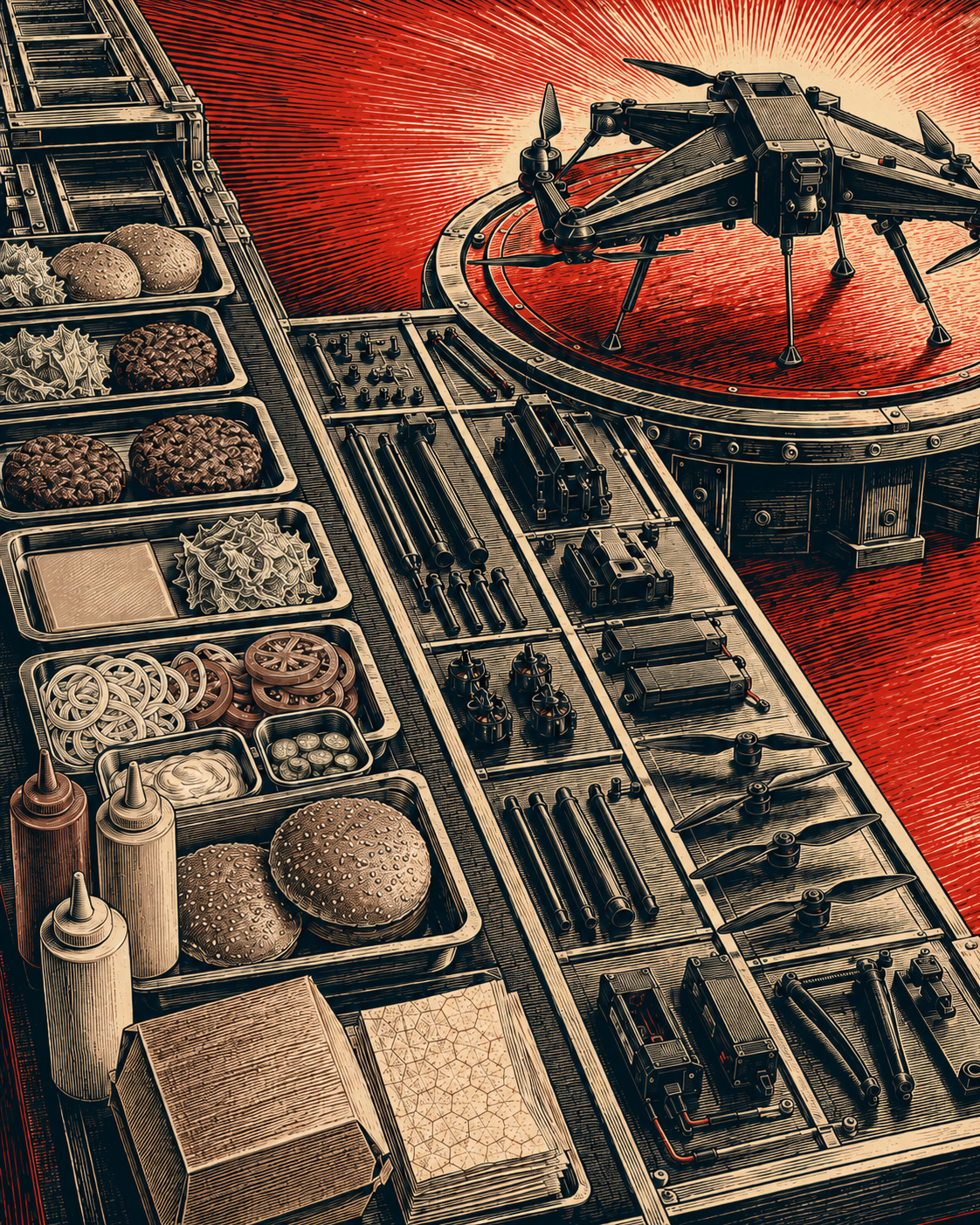
The Big Mac. It has two all-beef patties. It has the special sauce. And it has lettuce and cheese.
But, to our knowledge, it’s never been an example of how we can scale drone production. There’s probably a good reason for that - because last we checked there are no edible drones.
Yet lurking underneath the golden arches is the wisdom of the Toyota Production System that applies to any product. Not just tasty ones.
First, some background. McDonald’s really isn’t in the food business. It’s actually in three other businesses: the real estate business, the logistics business, and the manufacturing business.
Real estate? Yes, real estate. McDonald’s typically purchases a site location and then leases that location to a franchisee. McDonald’s is one of the largest property owners on the planet.
Logistics? Yes, logistics. McDonald’s has over 43,000 locations, each of which must supplies through McDonald’s-approved suppliers. And, because on average McDonald’s sells 900 million Big Macs per year (1.8 billion all-beef-patties), that means that there are an impressive number of daily deliveries and supply-chain movements required to keep the system operating.
Manufacturing? Yes, manufacturing. Not only does McDonald’s need to ship all of those Big Mac ingredients, it needs to make them. (Typically, though McDonald’s uses contract-manufacturers to make all of the all-beef-patties, french fries, and buns. And nuggets. And shakes.) But that’s not the only manufacturing done by McDonald’s.
Because if you go into a McDonald’s restaurant, you can see the Toyota Production System at work. Each McDonald’s restaurant is nothing more than a super-efficient production line that has the many of the same principles found in a Toyota manufacturing facility.
Production Diagram. There are over 10,000 steps to building a car and that’s why each step is visualized so that the production workers can see exactly how to put it together. It’s like a big Lego instruction manual with pictures, arrows, and everything else. McDonald’s has the same thing, like this Big Mac diagram listed in Instructables: https://www.instructables.com/How-to-Make-a-BigMac-From-Mcdonalds/
Backloaded Storage trays for Patties and Buns. One of the biggest issues in manufacturing is to make sure you have the right part at the right time at the right place of the production line. That’s why Toyota has a “pull” supply system. If, for example, the number of bolts is low, then a worker puts a card in the bucket and then another worker grabs the card and goes back to the main supply area, grabs more bolts but also puts another card in the main supply area to signal to the ERP to order more bolts.
McDonald’s does the same thing with “Big-Mac-parts” with their backloaded storage trays. As the “parts” are pulled from the front, then an employee from the storage room puts more “parts” from the rear. This allows the bürgermeister to focus on making the products instead of chasing down more supplies and it provides a signal to the employee in the storage room to order more “parts.”
Build to Order. Everything at McDonald’s is built on demand and can be built within seconds. As soon as an order comes through, it goes to a screen at each station and gives the operator a brief list of what they need to make. The screen also provides the wait time for each customer and flashes red when it reaches a certain limit. It can then be summed at the end of each day/shift to provide metrics on the team's performance.
What does this mean for the future of drone manufacturing? Historically, the drone industry has behaved more like an artisanal workshop than a modern factory, relying on low-volume, highly complex assemblies that require specialized labor and long lead times. But to achieve true scale—where fleets of drones can be deployed for everything from widespread logistics to continuous environmental monitoring—we have to stop thinking like boutique engineers and start thinking like fast-food executives. We need to modularize our builds.
At Modovolo, we are applying these exact principles of "Build to Order" and visual, standardized assembly to our own production lines. By designing our drones around uniform, repeatable components that can be quickly slotted into place using backloaded supply trays and intuitive assembly protocols, we eliminate the traditional bottlenecks of aerospace engineering. Our operators don't need to guess the next step or hunt down missing parts; the system is designed to flow seamlessly from a digital order queue to a fully functioning aircraft in record time.
Scaling drone production isn't about reinventing the assembly line; it's about adopting a system that already feeds billions of people every day. By treating "drone parts" with the same logistical discipline that McDonald’s treats "Big Mac parts," we can drive down costs, eliminate manufacturing errors, and dramatically increase output. The next time you see a fleet of autonomous drones taking to the skies, remember: it wasn't just aerospace science that got them there—it was the secret sauce of hyper-efficient manufacturing.
Comments