
CAPTAIN'S STARLOG
Why Finding Schrodinger’s Cat Creates Ultra-Efficient Propellers
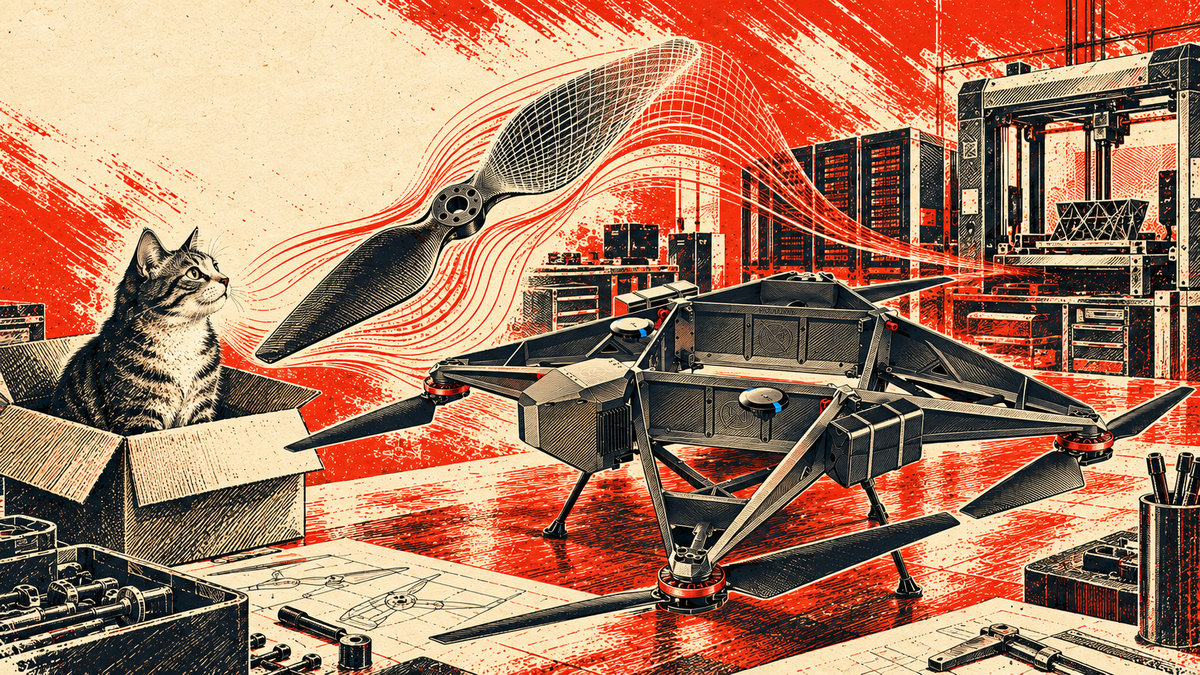
Cats, Propellers, and Syracuse Start-Ups. This is a story of a cat, propellers - and two Syracuse-area start-ups. One is BQP, a group of some of the world’s biggest nerds building the future of quantum-computing and artificial intelligence. The other is Modovolo, another group of big-time nerds building the future of drones.
And when two groups of nerds get together, lots of impressive things happen (and, let’s be honest, lots of other things don’t happen like: discussions about sports, fashion, or any pop culture references whatsoever).
One of those impressive things is thinking about cats in new ways. Oh, another is thinking about propellers.
Because as it turns out, not much has changed with propellers since the Wright Brothers and World War II. There are a couple of reasons for this. First, the end of WWII saw the dawn of the jet age, so research into standard propellers faded away. Well, research didn’t disappear entirely but in general it’s nothing compared to the research and development that has gone into jet engines.
So someone needed to come along with a nerdery and do something about that. Something impressive.
Schrodinger’s Cat. But before we talk about that, we need to first talk about cats. Specifically this guy Schrodinger’s cat. You see, in the early 20th century Schrodinger was one of the top theoretical physicists developing the new science of quantum mechanics, aka, the science of very small things (like quarks and other parts of atoms). Because, it turns out, quarks do some pretty strange things. One of those strange things is called “quantum superposition,” aka the universe’s ultimate “two-fer.” You can think of quantum superposition as flipping a quarter and, instead of getting a head or tail, you get a head and tail at the same time.
Or, if you want a more morbid metaphor, you can think of quantum superposition as Schrodinger explained it: a cat is placed in a sealed opaque box that has a vial of poison, a hammer on a spring-loaded hinge, and a radioactive decaying atom as a trigger. At any given time, there is a 50% chance that the radioactive atom trigger has decayed to the point where the spring-loaded hinge brings the hammer down, smashing the vial of poison. Or a 50% chance that the radioactive atom trigger hasn’t decayed. So the cat is dead and alive at the same time.
Quantum Computing. And for computer nerds, quantum superposition is the best thing to happen to computers since Alan Turing (the guy who invented modern computing).
Because, while not so great for cats, a computer that leverages quantum superposition (aka a “quantum computer”) can calculate many, many variables all at once. Why is that a big deal?
Well, modern computers are great: they’re very fast and can do many things. But they are limited to only calculating a few variables. And each variable radically increases the time it takes to compute something. 3 variables could take days. 4 variables could take weeks. 10 variables a year. You get the problem.
Let’s take a look at an example. Like a propeller. Because a propeller is a crazy complicated thing. And crazy complicated things have many variables. Why is that?
First, there are millions of points along a propeller blade and each point of the blade is spinning at different velocities: the tip is going near supersonic speeds (i.e., 700+ mph) and the base is going a fraction as fast, like 50 mph.
That means that along those millions of points the air flow is changing constantly. And the structural stresses on the propeller blade at each point are enormous and different. Then on top of all of that the RPMs of the electric motor are constantly changing as the pilot is maneuvering the drone. And there are wind, humidity, and many other environmental factors.
The net/net: all of those millions of points (i.e., air flow, propeller structural stresses, RPM changes, and environmental factors) are each a variable. And, because current computers can only handle a few variables, then that means current computers can only create a very crude simulation of a propeller design.
The 15% Trap: Current Computers are Choking on 1980s Math.
Why are current computers so limited? Well, if you pop open today's standard Computational Fluid Dynamics (CFD) software, it looks slick. You get rainbow-colored pressure gradients and high-tech 3D models.
But under the hood? It’s running legacy algorithms built for single-threaded processing. Most conventional CFD solvers process mathematical variables in series—one item after another. They treat a 64-core high-performance GPU like a line of 64 people waiting to use a single portable toilet.
And even though the hardware has massive parallel processing capabilities, the 1980s math forces it into a bottleneck. The result? Current classical CFD software utilizes only about 15% of a modern hardware stack's actual processing capacity. 85% of computing power is literally sitting on its hands, humming quietly. Because of this 15% computational bottleneck, traditional prop designers can only handle a handful of variables at a time. They test blade pitch, diameter, and chord length in a completely static vacuum—assuming calm, pristine, laboratory air.
Enter BQPhy: The "AWS of Quantum Computing"
This brings us to BQP and their groundbreaking platform, BQPhy. If classical computing is trapped using 15% of its brain, BQPhy is the unlock key that opens the missing 85%. BQP acts as the "AWS of Quantum Computing"—a software infrastructure layer that enables today's high-performance GPU clusters to execute quantum-inspired math in parallel threads. Instead of a 10x slow crawl, you get 10x GPU performance today.
And that performance gain is available today based on existing hardware - and not some future promise, as Christopher Gannatti, Chief Investment Officer of Wisdom Tree explains: “The capital markets have spent years waiting for pure 'quantum supremacy'—some far-off, cryogenic laboratory milestone where a quantum processor beats a supercomputer at an abstract puzzle. But allocators and engineers live in the real world. The real inflection point isn't waiting a decade for fault-tolerant hardware; it's hybrid acceleration today. The platforms that unlock the massive latent compute already sitting inside modern GPU clusters by rewriting legacy serial algorithms are the ones creating immediate economic and operational alpha.”
More Beefy Propellers
So let’s talk about propellers again. Specifically, beefy propellers.
Because BQP’s BQPhy platform unlocks that trapped 85% of computational power, Modovolo no longer has to settle for one-size-fits-all propellers.
Instead, Modovolo can dynamically design and manufacture optimized propellers for whatever the mission demands.
A few examples:
Heavy Payload Missions: If you need the Modovolo Lift drone to carry heavier payloads, BQPhy recalculates for high motor torque and maximum lift. Out pops a thicker, "beefier" propeller optimized for high-thrust performance.
Acoustic / Silent Operations: If you need to fly low-noise reconnaissance along an enemy line, we dial up acoustic constraints. The platform calculates geometries that minimize sound displacement while keeping flight efficiency high.
Extreme Weather & Endurance: Facing high-altitude mountain gusts or long-range surveying runs? BQPhy optimizes for wind shear variables to generate blades tuned for maximum flight time.
Once BQPhy determines the ideal design, Modovolo uses its patent-pending 3D-printing process to turn that digital twin into physical prop hardware in record time at the tactical edge.
But propellers are just the beginning. The next frontier for BQP and Modovolo is to design entire airframes, motor systems, and other components - all in real time, i.e., as new information and mission parameters change, so will the airframe, motor systems, and other components.
Highlighting the profound shift this represents for manufacturing and aerospace economics, Gannatti notes: "Historically, industrial hardware design has been defined by brutal, static compromises because physical simulation was too computationally expensive to personalize. When you can collapse the design cycle of physical hardware from months to hours using physics-informed AI and quantum math, the economics invert completely. You move from rigid, depreciating capital equipment to agile, dynamic manufacturing where the hardware adapts directly to the problem in real time."
So BQP and Modovolo opened the box, found Schrodinger’s cat, and proved that when you unlock the missing 85% of modern computing power, you never have to settle for compromised, static drone components ever again.
Today, we're printing mission-customized beefy propellers at the tactical edge—and tomorrow, as BQP's quantum-inspired algorithms evolve alongside Modovolo's rapid manufacturing, every single piece of an aircraft will morph in real time to meet the mission.
The era of off-the-shelf, one-size-fits-all aviation is officially over; the future belongs to dynamic, physics-AI-driven hardware.
Comments