
CAPTAIN'S STARLOG
Why Ants, 100-Year-Old Math Equations, and Shameless Promotion of the Modovolo Lift Define the Future of Warfare
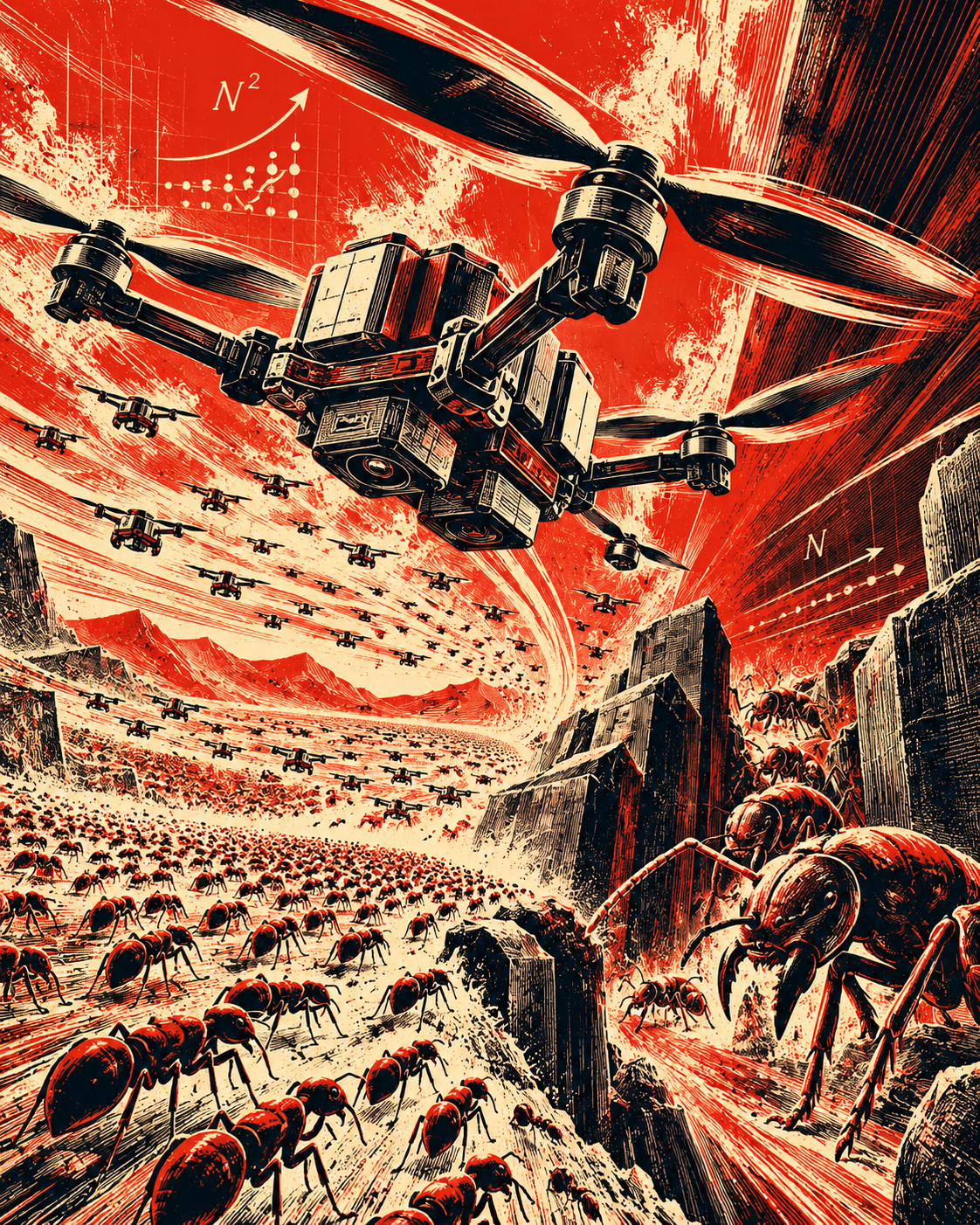
In the grand tradition of the Modovolo blog, this post is all about things that are completely (or seemingly) not related to drones at all. We’ve made excellent comparisons of drones to anvils. And to toilets. And in this case we’re going to talk about ants.
Specifically, let's talk about Australian Meat Ants and Argentine Ants.
If you put a single Australian Meat Ant—which is essentially the biological equivalent of an armored main battle tank—in a ring against a single Argentine Ant, the Meat Ant wins every single time. It’s bigger, stronger, and built like a…main battle tank.
So when the invasive Argentine Ant started invading Australian turf, you’d expect the native Meat Ants to crush them into oblivion, right?
Except they didn’t. The tiny, fragile Argentine Ants routinely massacred the Meat Ants.
How? By understanding a math problem solved in 1914 by an English engineer named Frederick Lanchester.
The Math That Drives Massacres
During World War I, Frederick Lanchester tried to figure out how aircraft and modern long-range weapons were changing combat. He came up with two differential equations that are now known as Lanchester’s Laws:
1. Lanchester’s Linear Law (Old School Combat): When combat consists of individual, sequence-based duels (think ancient line infantry, dueling snipers, or narrow choke points), force capability scales linearly with numbers. Ten units with 1x power equal ten total power. Quality matters just as much as quantity.
2. Lanchester’s Square Law (Modern Aimed Fire & Open Arenas): When multiple combatants can focus their fire simultaneously on a single target in an open environment, force capability doesn't scale linearly with numbers—it scales with the square of the number of units.
Mathematically:
Fighting Power = Individual Fighting Quality * Number of Units2
Read that formula again. Numbers are squared. Quality is not.
If Army A has 5 elite units (Quality = 2) and Army B has 20 cheap units (Quality = 1):
Army A’s Fighting Power: 2 * 52 = 50
Army B’s Fighting Power: 1 * 202 = 400
Despite being individual "underdogs," Army B possesses eight times the effective combat power because they can concentrate force.
This is exactly how Argentine ants win. In open terrain, five tiny Argentine ants jump on one giant Meat Ant at the exact same time. The Meat Ant's superior armor doesn't matter because it's being pinned from five angles simultaneously. Lanchester’s Square Law at work.
Unless... you change the environment.
A recent 2023 study pitted these exact ant species against each other in different environments. When researchers added complex terrain—tight corridors, obstacles, and choke points—the Argentine ants lost their ability to concentrate force. The battle reverted from the Square Law back to the Linear Law.
In the tight corridors, it was 1-on-1 duels again. The giant Meat Ants crushed the smaller ants easily.
Is Modern Warfare Linear or Square?
For the last 80 years, militaries have arguably followed the "Meat Ant" strategy: building exquisite, multi-million-dollar capital assets (F-35s, Abrams tanks, aircraft carriers, $1M air-defense missiles) designed to win 1-on-1 duels against any adversary on Earth, which seems to strongly assume battlefield terrain or long-range stand-off distance would force the enemy into Lanchester’s Linear Law.
Then came modern low-cost aerial autonomy.
Drones have purportedly flattened the battlefield. It seems that in a post-drone world the sky has no "tight corridors" or "choke points." Airspace becomes an open 3D arena. And when you unleash cheap, distributed, autonomous systems into an open arena, it could be argued that combat shifts back into Lanchester’s Square Law.
A $2,000,000 exquisitely designed defense system might have a "Quality Factor" 100 times better than a simple $1,000 micro-drone.
But if the enemy sends 200 micro-drones:
Exquisite System Power: 100 * 12 = 100.
Drone Swarm Power: 1 * 2002 = 40,000
Mass wins when you can concentrate force in open space.
The Trap: You Can’t Just Be a "One-Trick Ant"
So, does this mean everyone should just buy 50,000 identical $500 FPV attack drones and call it a day?
No. Because just like the ants, the battlefield state shifts depending on environment, electronic warfare (EW), and logistics.
If all your swarm does is blow itself up on contact, what happens when the enemy turns on heavy RF jamming or retreats behind covered positions? You’ve built a massive army of "small ants" that suddenly gets funneled into a choke point and wiped out.
True operational dominance under Lanchester’s Laws requires **swarms with functional diversity.** You need to manipulate the Square Law to your advantage across every phase of combat, not just the terminal strike.
And that brings us to the shameless promotion of the Modovolo Lift.
How the Modovolo Lift Weaponizes Lanchester’s Laws
At Modovolo, we didn't design a single-use drone. We designed a modular utility platform built on low-cost, rapidly scalable manufacturing.
Because one frame with interchangeable pods allows a single tactical commander to dynamically shift the Lanchester math in real time across the entire battlespace:
1. Sensor Density (ISR Payload): Fulfilling the Square Law Equation
To use Lanchester’s Square Law, you have to be able to see and target enemy units simultaneously. A swarm of 30 Modovolo Lift drones carrying ISR (Intelligence, Surveillance, Reconnaissance) payloads creates a ubiquitous sensor mesh. You aren't peeking through one high-value optic; you have 30 eyes squaring your situational awareness.
2. Kinetic Saturation (Munitions Dropper & FPV Mothership): Executing Massed Firepower
Once targets are identified, the platform switches roles. A cluster of Lift drones carrying precision payload droppers or acting as FPV motherships (releasing tethered or kamikaze micro-drones right over the target) allows a small squad to unleash concentrated, simultaneous firepower. You force the enemy to defend against 20 vectors at once, instantly invoking the exponent in the Square Law.
3. Sustainment at the Point of Friction (MREs & First-Aid Kits): Maintaining Unit Density
Lanchester's equations assume your force numbers stay active in combat. The second a squad runs out of ammo, batteries, or medical supplies, their effective force number drops to zero, and the math flips against them. A Modovolo Lift configured to hot-drop First-Aid kits, blood bags, or MREs directly to pinned-down units preserves force density without putting high-value medevac helicopters at risk.
4. Electronic Counter-EW & Relay Pods: Preventing Environmental Bottlenecks.
When the enemy tries to create "corridors" using electronic warfare jamming to break up your swarm, a dedicated Lift drone carrying a signal relay or EW counter-pod clears the pipeline. It restores communication, keeping the swarm linked so the math stays firmly on the side of the Square Law.
The Bottom Line
Militaries that spend all their budget on a few giant, invincible "Meat Ants" are at risk to be systematically dismantled by flexible, mass-produced swarms in open terrain.
But militaries that only build single-purpose suicide drones will find themselves useless when the battle conditions change.
The winner of tomorrow’s conflict won't be the side with the most expensive single asset, nor the side with the cheapest single toy. It will be the side that can field **mass, modularity, and multi-role payload diversity** faster than the enemy can recalculate the math.
Nature figured this out millions of years ago. We just put propellers on it.
Comments