
CAPTAIN'S STARLOG
The Garage Days
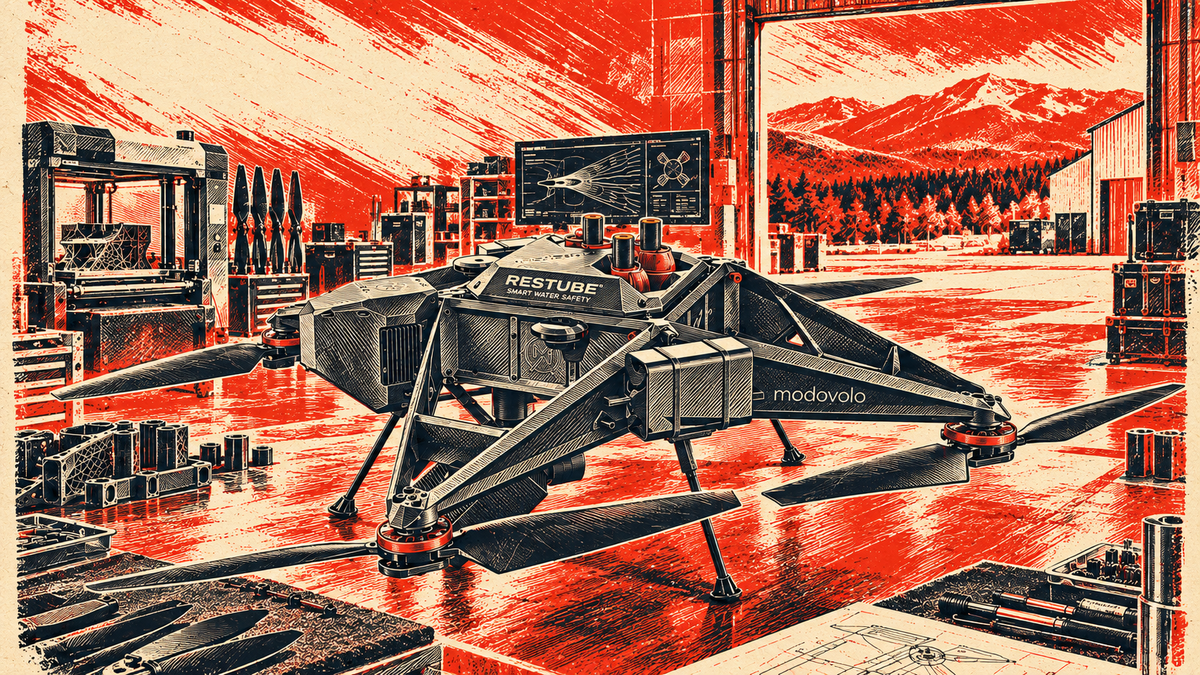
The humble garage is the birthplace of many storied American companies: Hewlett-Packard, Apple, and….Metallica.
And Modovolo is just like those storied American companies. Well, Modovolo is still in a garage (albeit a much nicer and bigger one than where they started) and, well, Modovolo is not “storied” yet.
But one of Modovolo’s engineers is in a metal band called “Sons of Aurelius,” which is so bad ass that it makes Metallica sound like an Irish folk band.
Anyway, getting back to garages. And drones. And the origin story of Modovolo and the Modovolo-BQP partnership.
Ironically this all started in 2019 at a business plan competition in the sunny, warm, snow-free expanse of territory known as Upstate New York (specifically Rome, NY).
But the business had nothing to do with drones. At the time the Modovolo co-founder, Justin Call, was leading a construction technology start-up called Go Figure and his pitch won the grand prize of $200k. And the other co-founder, Arion Mangio, was in the audience.
“So the business plan competition is over,” Justin Call recollects. “I had just finished talking with dozens of people congratulating us and the Go Figure team and we were packing up our booth. And this guy comes up to me and says: ‘I’ve got an idea for a business. Could we talk?’”
“I don’t know why I took him seriously but somehow I knew this guy was legitimate,” continues Justin.
They had an initial meeting where Arion and Justin talked about how current drones suck - they were too expensive and had barely any flight time - and they talked about how most companies suck.
“I had left the Air Force and joined a commercial drone testing company. It was one of those experiences that was both great and awful at the same time. I got to see and fly dozens of drones. And this made me realize that current drone design just doesn’t work. But it was also an awful experience because the executives of the company were micromanagers and engaged in many, many bad management practices. I felt completely demotivated. I never understood why they hired smart people but they refused to let them think.”
And this is also when Justin learned about Arion’s insane background.
“Arion is like a modern day high-tech Renaissance-man - and if he were inclined to brag, he might even be annoying” jokes Justin. “He’s an aerospace engineer. Former Air Force captain. Former C-130 pilot. Cyber security expert. Commercial drone pilot. And just all around tech nerd.”
And then after that initial meeting nothing happened for a few years.
Well, not exactly nothing. Arion had his first child. Justin was busy paying for college tuition for his 4 kids. And Arion and Justin became good friends, mostly because they realized that they were both technology and business nerds with dreams of creating a great and enduring company.
“We actually didn’t talk much about drones for a long time,” explains Justin. “We talked about what made smart people happy and companies great. We read many books and shared notes. We talked about how to rethink what a company is and what a partner is.”
“We also talked a lot about where I was working at the time,” continued Arion. “And how our company had to be different. We knew we were going to hire smart people and we needed to get out their way.”
“Even though we didn’t have an actual product, we came up with the name, Modovolo. Well, Arion did. I loved the name so much but I thought that there was no way it was available as a domain name. But for $19.99 on Go Daddy, it was ours. It was definitely meant to be.”
Neither of them recall the catalyst that finally motivated them to get serious about iterating and testing on new drone designs, but it finally started to happen by 2022.
“The initial concepts were nothing like what the Modovolo Lift looks like today. We started doing what most every engineer does - optimizing the current fixed-center hub-and-arm drone design that everyone else uses and utilizing off-the-shelf propellers.”
“But it became apparent after a few months that the fixed center hub and arm design wasn’t going to work. In order to make that design light, you need to use exotic materials. But exotic materials are expensive and hard to manufacture. We had to find a different way to get to way better performance but at a radically reduced price.”
This is when Modovolo started designing and building its own components and propellers. And that meant additive manufacturing.
“We bought several 3D printers and we tested and iterated as we were designing and building our drone prototypes. But these commercial 3D printers didn’t work. They were very expensive and they couldn’t print the plastics we wanted to use. And they were slow. Far too slow for production,” explains Arion.
It just happened that at the same time Arion and Justin were reading “Driving Honda,” a book about the history of Honda, and they found an idol in its founder, Soichiro Honda - especially when Soichiro decided to move from designing and building just motorcycles to also cars.
“Soichiro went to the USA to buy equipment for his new car production line. But he found that he couldn’t afford the massive stamping machines and other production equipment to build his new cars. So on his flight back to Japan he decided that he and his team of engineers would just build that equipment themselves, a tradition that Honda carries on to this day for much of their production equipment,” explains Justin.
Arion continues, “It’s one of the reasons why Honda’s production lines are flexible, allowing multiple different models to be built on the same production line. It’s also why Honda is very efficient - more so than Toyota - because Honda’s production equipment is tailor-made for exactly what Honda needs (and Honda doesn’t need to repurpose machines from other vendors).”
That then started a co-development process where Arion and Justin were iterating not just on the drone design but also on how to build the machines that would build the drone.
Justin explains, “The 3D printer and drone designs were an evolution of an evolution of an evolution with dozens and dozens of failures. The problem was: designing and building something with maximum payload capacity and for long flight time but also keeping costs down.”
Arion explains, “It turned out that materials were the biggest challenge. Nothing worked. It’s why everyone designs drones the same way and uses aluminum, ABS, and carbon fiber. It’s relatively easy to work with those materials. But they were too expensive and didn’t hit our weight targets. It took over a year to find a solution. I honestly began to doubt we’d solve it.”
But it’s a problem they did solve. While they had done many, many bench tests, it took two years before the first real test flight. It was then that they knew they had something special.
“On our first test flight we flew 2 hours. It was just unreal,” noted Arion.
And by 2024 it was clear that they then needed to come out of stealth mode with the design to see what drone operators thought of it. “We needed to get critical feedback from drone operators. We thought that we were on to something but you don’t know until you show the experts.” So in the Summer 2024 they launched the website and nearly instantly saw both positive and negative feedback.
“People were excited about the design and the flight time capabilities for such a low cost but we also heard a lot that people think we are full of shit. We get it. We would be skeptical too so we just need to prove that we can do what we are saying.”
It was that excitement that enabled Modovolo to raise a pre-seed round and then a follow-on $2 million seed round 9 months later (including being selected to join and get investment from the very exclusive GeniusNY business accelerator program for drone start-ups.).
And this is when Arion and Justin started building the right team and culture. It’s a team of freaks and geeks who share the same mission and vision: air mobility for everyone and the democratization of flight. Our B.H.A.G. (Big Hair Audacious Goal inspired by Jim Collins): Modovolo will be the dominant air mobility platform of the 21st century.
“We’re very careful about whom we hire. We have a set of 4 hiring criteria: 1. The person can’t be an asshole, 2. They must be intellectually curious, 3. They must be hard working, and then if they have passed 1-3, we ask: do they have any skills?” explains Justin.
“That’s when we brought on our current team of 8, including Gabor Paulke, our Chief Design Officer, and Jackson Taunton, our Chief Product Officer,” explains Justin. “And we really started taking off. Pun intended.”
“Gabor is an epic designer,” continues Justin. “He designed the iRobot Roomba, the interior of the Airbus A380 super jumbo jet, and the Clover payment system hardware. And he has this amazing ability to distill a product down to its essence. He asks: what is the fundamental purpose of the product?”
“Jackson is the biggest drone-product nerd on the planet. He lives and breathes drone technology,” explains Arion.
With the initial executive team in place, their initial focus was on thinking through and drafting the Modovolo Principles.
“The first Modovolo Principle is what we call ‘performance-to-cost.’ This means that we only design and build products that have high performance but at radically reduced cost,” explains Justin.
“Under the performance-to-cost principle, Gabor and Jackson were able to transform the initial prototypes to create Modovolo’s first product, the Lift. It’s industry’s first payload-centric design that can perform 100s of different missions with longer flight time but at a cost far below competing systems - even from China,” explains Arion
“In order to increase performance and reduce cost at the same time, we had to remove complexity from our designs. We needed to reduce the part count. Competing drones have 2000+ parts but the Lift has only 118 parts. Fewer parts means less weight so longer flight time, more durable because less things to break, and easier to repair. Everything gets better when you simplify,” explains Gabor.
“And you need to master every aspect of the drone: additive manufacturing, propellers, etc. You cannot just focus on point solutions. You need to design and build a system,” explains Jackson.
“That’s why we designed and built the BFP, our own proprietary additive manufacturing production printer. We can utilize the latest in material science, and the BFP is way faster and higher quality - but costs orders of magnitude less than competing additive manufacturing systems. The BFP alone is a breakthrough in capability,” continues Jackson.
“Another key principle is ‘walking-the-gemba,’ something we’ve borrowed from Toyota. It means that you need to understand the problem fully before you can talk about solutions. It’s also why there is a bias to internally develop our own production equipment because it forces walking-the-gemba in an extreme way,” explains Arion.
“Since we have designed our own additive manufacturing capability, we have become deep experts. So much so that one of our plastics manufacturers couldn’t figure out how to print its own plastic filament and they came to us to figure it out. And we did in a few hours,” explains Jackson.
And then something unexpected happened. Modovolo got accepted into GeniusNY.
For those unfamiliar, GeniusNY is one of the most competitive drone and advanced air mobility accelerator programs in the world. It is also one of the reasons that Upstate New York has quietly become what Commercial UAV News once called the "center of the drone universe." Between the FAA-designated UAS test sites, research institutions, defense contractors, airspace infrastructure, and a growing ecosystem of drone companies, there are few places on the planet where so many drone nerds have been concentrated into such a small geographic area.
"People often think of Silicon Valley when they think of technology clusters," explains Kara Jones, Director of GeniusNY. "But Upstate New York has built something unique around uncrewed systems. We have entrepreneurs, operators, manufacturers, regulators, researchers, investors, and end-users all working together in one ecosystem. That's incredibly difficult to replicate."
For Modovolo, GeniusNY was more than funding. It was validation.
"We see hundreds of companies from around the world," explains Kara Jones. "What stood out about Modovolo was that they weren't trying to build a slightly better drone. They were rethinking the economics of drone design itself. Their focus on performance-to-cost, manufacturing innovation, and simplifying complexity aligned perfectly with what we look for in transformative technologies."
And perhaps more importantly, GeniusNY introduced Modovolo to a community of founders who were solving adjacent problems.
Today Modovolo works closely with fellow GeniusNY companies including Skyfire, FlyHound, and Lighthouse Avionics. While each company attacks a different challenge—from emergency response and public safety operations to airborne detection systems and advanced avionics—they all share a common belief that the future of aviation will be increasingly autonomous, increasingly intelligent, and dramatically lower cost than it is today.
"One of the most powerful aspects of GeniusNY is the network effect," explains Kara Jones. "The companies don't just coexist. They collaborate. The most successful founders understand that building a new industry requires partnerships."
And perhaps no partnership better illustrates Kara's point than Modovolo's relationship with BQP, a quantum computing start-up also based in the Syracuse, NY area.
Because, on the surface, a drone company and a quantum computing company doesn’t sound like a natural partnership until you contemplate the Modovolo Principles.
"Our performance-to-cost principle means that we are systematically designing the entire drone and not just point solutions," explains Justin. "The challenge is that once you start optimizing every part of the system, you eventually run into problems that are unbelievably difficult to solve."
One of those problems turned out to be propellers.
As Modovolo continued to improve the Lift platform, the team became increasingly convinced that conventional propeller design was leaving enormous amounts of performance on the table. The problem wasn't a lack of ideas. It was a lack of computational capability. Every point along a propeller experiences different aerodynamic forces, different velocities, and different structural loads. The number of potential design combinations quickly becomes absurd.
Or, to use the technical engineering term: a giant pain in the ass.
This is where BQP entered the picture.
"Quantum computing has so much promise, but it has largely been stuck in the theoretical," explains Abhi Chopra, co-founder and CEO of BQP. "We started BQP with the mission of bringing quantum computing into practical applications. Working with Modovolo allows us to do exactly that. We're no longer talking about theory. We're designing real products that will fly in the real world."
Arion continues, "We have a patent-pending process for manufacturing propellers that dramatically reduces production cost. What we were struggling with was unlocking the next level of performance. That's why BQP is so important. Their quantum capabilities allow us to explore design possibilities that simply aren't practical using conventional methods."
The results have been surprising.
Actually, that's an understatement.
The resulting propeller designs look dramatically different from what most of the drone industry would consider normal. Some of them look like they were designed by an aerospace engineer. Others look like they were designed by an aerospace engineer who had not slept for several days and had begun receiving instructions from an alien civilization.
And that's precisely the point.
For years, the drone industry has been asking, "How do we make skinny propellers a little better?" BQP's quantum systems allow Modovolo to ask a different question entirely: "Why are we using skinny propellers in the first place?"
As Abhi explains, "When you can evaluate vastly larger design spaces simultaneously, conventional assumptions become optional."
Or, put another way, conventional wisdom becomes a target-rich environment. And if there is a common thread running through the Modovolo story, it is the refusal to accept unnecessary complexity that conventional wisdom creates.
When drones were too expensive, the answer wasn't to accept the price. When manufacturing equipment didn't exist, the answer wasn't to buy something close enough. When conventional propeller design hit its limits, the answer wasn't to settle for incremental improvements. At every stage, the question was the same: what if everyone is solving the wrong problem?
That mindset led to a new drone architecture. It has led to proprietary manufacturing systems. It led to partnerships with companies like BQP. And it continues to drive everything Modovolo does today.
Comments